Have you ever read a Bible verse and stopped at the word iniquity? It is a strong word, and it can sound difficult or even frightening. Many Christians search for the iniquity Bible meaning because they want to understand what the Bible really means when it talks about iniquity.
In simple words, iniquity means deep or repeated wrongdoing, especially when a person turns away from God’s righteous ways. It is more than making a small mistake.
The word can point to a sinful attitude, a wrong way of living, or a pattern of actions that goes against God.
The Bible uses the word in many important passages. It appears in prayers of repentance, warnings about sin, and beautiful promises of forgiveness. So, the message of iniquity is not only about judgment. It also points toward mercy, repentance, healing, and restoration.
Understanding this word can help us read Scripture with greater care. It reminds us that God sees the heart, knows our struggles, and calls us back when we go the wrong way.
So, what does iniquity mean in the Bible, and what spiritual lesson can we learn from it? Let us explore its meaning through Scripture, faith, and God’s mercy.
Iniquity Bible Meaning
The biblical meaning of iniquity is closely connected with sin, wickedness, injustice, and moral wrong. In the Bible, iniquity can describe actions or attitudes that are against God’s will.
One important verse is:
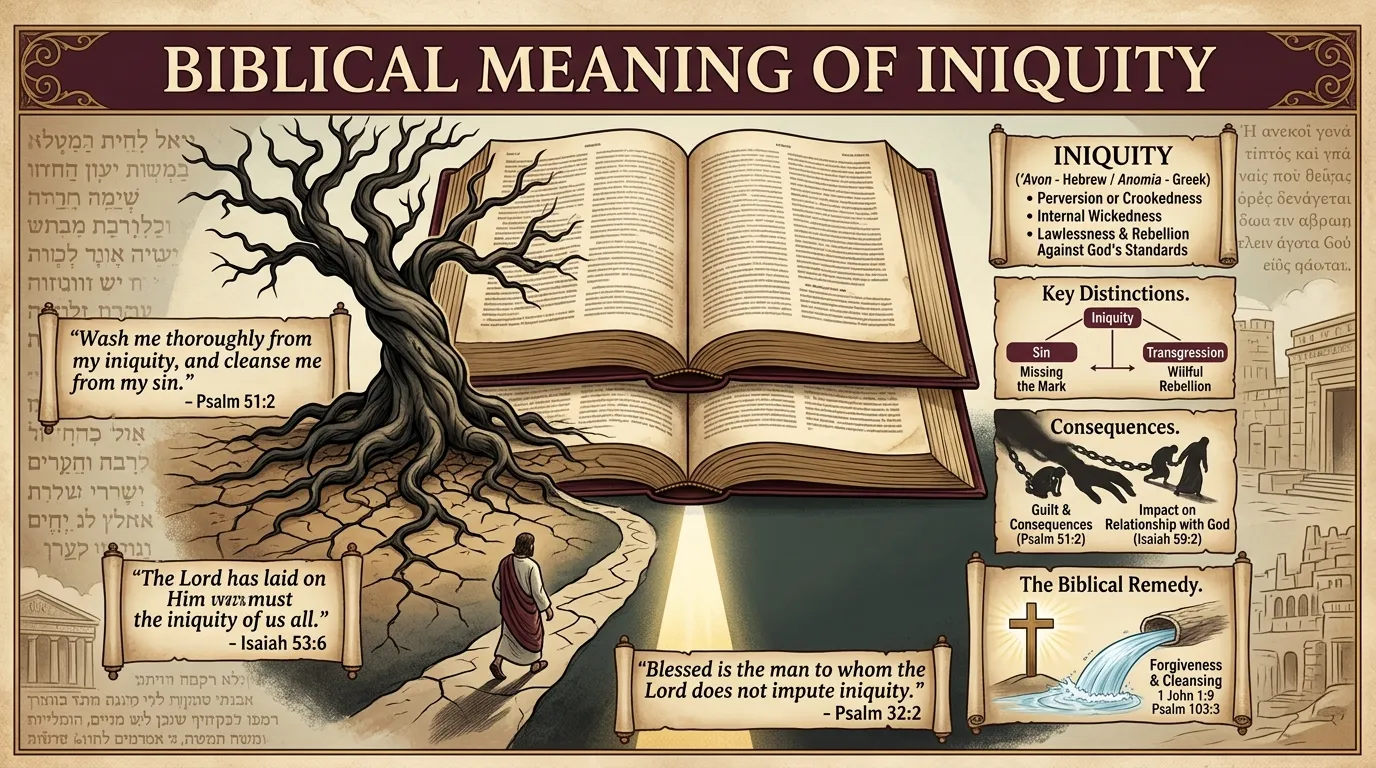
“But your iniquities have separated between you and your God.” — Isaiah 59:2
This verse shows that iniquity can damage a person’s relationship with God. Sin creates distance because God is holy and righteous.
Iniquity Means More Than a Simple Mistake
The Bible often uses different words for wrongdoing. Sin can describe missing God’s standard. Transgression can describe breaking a command. Iniquity often carries the idea of crookedness, guilt, or deeply rooted wrongdoing.
This does not mean that every person who struggles with sin is beyond hope. The Bible gives a message of mercy again and again.
Psalm 51 is a powerful example. After recognizing his sin, David prayed:
“Wash me thoroughly from mine iniquity, and cleanse me from my sin.” — Psalm 51:2
David did not hide his wrongdoing. He brought it honestly before God.
This teaches an important spiritual lesson: confession can become the beginning of restoration.
Iniquity and the Human Heart
Iniquity can also describe a pattern that grows within a person’s life. A person may know something is wrong but continue choosing it. Over time, the wrong choice can become a habit.
Jesus also taught that sinful actions can come from within the heart. In Mark 7:21–23, He explains that evil thoughts and sinful actions can come from inside a person.
The Bible therefore encourages believers to look beyond outward behavior. Christian faith also involves allowing God to change the heart, thoughts, desires, and choices.
God Offers Forgiveness for Iniquity
One of the most comforting Bible truths is that God does not only expose iniquity. He also offers forgiveness.
Psalm 103:12 says:
“As far as the east is from the west, so far hath he removed our transgressions from us.”
This verse gives hope to anyone carrying guilt.
Another beautiful promise appears in Isaiah 1:18:
“Though your sins be as scarlet, they shall be as white as snow.”
The message is clear: God’s mercy is greater than human failure.
Iniquity and Jesus Christ
For Christians, the meaning of iniquity is deeply connected with Jesus Christ. Scripture teaches that Christ came to deal with the problem of sin.
Isaiah 53:5 says:
“He was wounded for our transgressions, he was bruised for our iniquities.”
This verse points to the sacrifice of Christ. Christians believe that Jesus willingly suffered so that people could receive forgiveness and reconciliation with God.
Therefore, studying iniquity in the Bible should not leave us only with fear. It should also lead us toward the cross, repentance, grace, and hope.
Spiritual Significance and Symbolism of Iniquity
The spiritual meaning of iniquity can be understood as a call to examine our lives and return to God.
Iniquity reminds us that sin is not only about breaking rules. It can affect our thoughts, relationships, choices, and spiritual life.
A Call to Repentance
When Scripture speaks about iniquity, it often encourages people to turn away from wrong.
Repentance means changing direction. It means recognizing sin, turning from it, and seeking God.
For example, if someone has allowed anger to control their words, they can ask God for help and begin learning patience. If someone has acted dishonestly, they can choose truth.
This is spiritual transformation in everyday life.
A Reminder of God’s Holiness
Iniquity also helps us understand God’s holiness. God is righteous, pure, and just. His standards show us the difference between right and wrong.
This does not mean Christians must live in constant fear. Instead, God’s holiness can guide believers toward better choices.
A Message of Grace
Perhaps the most hopeful lesson is grace.
When we see our failures clearly, we can also understand why God’s mercy matters so much. A Christian does not need to pretend to be perfect.
1 John 1:9 teaches:
“If we confess our sins, he is faithful and just to forgive us our sins, and to cleanse us from all unrighteousness.”
This offers comfort to people who feel ashamed, tired, or far from God.
Biblical Interpretations of Iniquity in Dreams or Real Life
If you see the word iniquity in a dream, hear it during prayer, or repeatedly notice it while reading Scripture, it is wise not to assume that it is automatically a direct divine message.
From a Christian perspective, such an experience may encourage self-reflection and prayer. You might ask, “Is there something in my life that I need to surrender to God?”
For example, dreaming about being accused of wrongdoing could reflect feelings of guilt or fear. A dream about confessing wrongdoing could remind someone of the importance of repentance. However, dreams can have many causes, so they should always be tested carefully against Scripture.
The safest approach is to pray for wisdom and guidance rather than becoming fearful.
God’s message throughout Scripture is not simply, “You have failed.” It is also, “Return to Me.”
Practical Lessons and Faith Insights
The iniquity Bible meaning gives us several simple lessons:
- Examine your heart.
- Confess wrongdoing honestly.
- Turn away from harmful choices.
- Ask God for strength to change.
- Trust in Christ’s forgiveness.
- Extend mercy to others.
Do not allow guilt to keep you away from God. Let repentance bring you closer to Him through prayer, faith, and trust.
Conclusion:
The iniquity Bible meaning goes much deeper than simply calling something “wrong.”
In Scripture, iniquity points to sin, wrongdoing, and patterns that can pull a person away from God. It reminds us that our choices matter and that sin can affect our hearts, relationships, peace, and walk with God.
But the Bible does not speak about iniquity only to make us afraid. It also gives us a message of hope, mercy, and forgiveness. When we recognize our wrong actions, we do not have to hide from God. We can come to Him honestly through prayer and repentance.
Psalm 51 shows this beautiful truth. David recognized his iniquity and asked God to cleanse him. His prayer teaches us that failure does not have to be the end of our story. God can restore a heart that turns back to Him.
For Christians, the message becomes even more hopeful through Jesus Christ. Isaiah 53:5 says that Christ was “bruised for our iniquities.” This points to the sacrifice of Jesus and the Christian belief that He came to bring forgiveness and reconciliation with God.

I am Adam Grant, an author at BibleMeaniing.com. I focus on sharing insightful Bible-based content that encourages reflection, learning, and personal development. My mission is to help readers discover the relevance of God’s Word in today’s world.